And She Infects Some Friends – And So On
Special
Studies Exhibit Showing Selected Artist Drawings, Essays, And Proofs
For “The World United Against Malaria“ Campaign.
Synopsis
Historical Background:
On October 21st, 1960,
at the 26th Session of the World Health Organization, it was discussed that the
underfunded “Malaria Eradication Special Account” needed another way to finance
the program. The proposal was made for the issuing of postage stamps world-wide
in order to help fund the “global program for the eradication of malaria” and
increase world-wide publicity and education about the fight against malaria.
The hope was that the participating governments would contribute stamps or a
percentage of the proceeds of the sales of the stamps to the program. The
campaign ultimately failed due to the impossibility of eradicating the insect
and the disease. In 1962, over 100 countries produced stamps, souvenir sheets,
or slogans with the ‘World United Against Malaria“ theme.
Quote
from the World Health Organization (W.H.O.):
“About 40% of the world’s population, mostly those living in the poorest
countries, are at risk of malaria. Of these 2.5 billion people at risk, more
than 500 million become severely ill with malaria every year and more than 1 million die from the effects of the disease.”
Scope:
This
special studies exhibit has a few different stories being told.
The
philatelic story is that this is a special studies exhibit concentrating on the
pre-production material for philatelic items that were part of “The World
United Against Malaria” campaign from 1962 (items issued from late 1961 to
early 1963). Items included are artist drawings, essays, sepia proofs, die
proofs, progressive proofs, trial color proofs, and other proofs.
The
second story being told is described within the “How To
View This Exhibit”.
How To View
This Exhibit:
The flow
of the exhibit should be viewed in manner of the Breck Shampoo commercial from
the 1970s. Near the end of the commercial, there was a woman on the television
and she explains how she tells some friends about Breck Shampoo and they tell some
friends who tell some friends and so on until the whole television screen is
filled with pictures of friends. This is viral marketing at its best. Although
malaria is not a virus, it can rapidly spread (and as stated above from the
W.H.O.: 500 million are effected each year) – but instead
of word of mouth, it is word of blood.
There
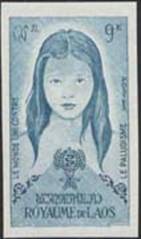
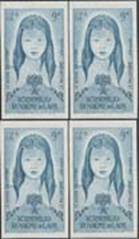
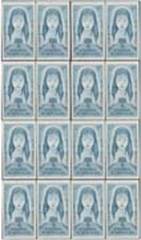
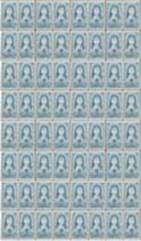
are mock views of the television advertisement below (images of malaria stamps from
Laos were used instead). As you can see, the number of images increases exponentially
and the idea that thousands of people will know about the shampoo through word
of mouth quickly becomes apparent.
So,
for this exhibit, the same ‘viral’ marketing concept will be used.
When an
infected anopheles mosquito takes blood meal from a human, parasites are passed
into the victim’s blood. After a period of time, the parasites reproduce and
continue growing and spreading in the bloodstream. New mosquitoes that suck
blood from this human ingest parasites which now continue its cycle within the
mosquito and now this mosquito can now affect many other humans. The cycle currently
goes on and on forever. And of course each infected mosquito can take blood
meals from many humans infecting many other humans. And so on and so on!
There
are logically only 6 sections/pages in this exhibit within the 5 frames:
- A four page title page which
describes through text and philatelic items how the spreading of malaria
from a mosquito to human and then back to mosquito and then so on. The
rest of the first frame is a single large artist drawing for the Laos
10-kip issue. The
painting is on canvas that measures 23”×29”. The one mosquito represents the first
mosquito in the spreading of malaria – similar to the first woman in the commercial.
- The second frame contains artist
drawings and essays. These items are spread out through the frame and the
effect should be that one infected mosquito has now grown in numbers. The
items are spread out and there is white space signifying that the
spreading has only started and seems controlled.
- The third frame contains mostly
signed die proofs and sepia proofs. The number of items in the frame has
more than doubled. White space is disappearing and the amount of
mosquitoes of the page are multiplying and starting to get out of control.
- The forth frame contains
progressive proofs, meter bromides, perforated trial colors, proof cards
and some smaller proofs. Once again, the number of items in the frame has
dramatically increased and the amount of white space is getting much sparser.
At this point, the spreading of malaria is definitely getting out of
control.
- The fifth and last frame shows
close to 1000 trial color proofs in full panes. These are close together
and there is almost no white space. This is similar to the today’s malaria
situation. With over a million people dying a year, 500 million people getting
infected, it is definitely out of control and is the current state of the
disease in the world today.
Highlights include but not limited to:
The
first frame includes the large artist drawing at the bottom from Laos which is
unique.
The
second frame includes artist drawings and essays and all of these items are
unique.
The third frame has a group of signed engraver’s die
proofs. There are 26-30 of these proofs created, some are signed and some are
not. These two types of proofs are not
the abundant French Area deluxe proofs that are produced as gratuities for
government officials and foreign dignitaries and produced in great numbers. The
third frame also includes Sepia proofs. There are only 3-5 of these produced
and one copy goes to the Official Archives, Postmaster, and Printing Office,
thus leaving only up to two that can eventually makes it into the public
sector. If a defect is found, the die is corrected and another set of 3-5 are
created for review.
The forth frame contains more items that were
produced in low numbers. The progressive proofs from the Philippines and Congo
are unique. There are 3 cards with proofs from Colombia proofs which are all
unique.
All of the full panes of color proofs may be unique.
These items have survived dealers hands that may have cut these up into blocks to
sell and are philatelic gems. I have emailed hundreds of specialized collectors
and no one has replied with having any similar full panes of trial colors for
malaria items.
Material Availability:
I
have been in contact with hundreds of dealers worldwide in search of these
malaria proofs for the last dozen or so years and this is my only collecting
area. Over the last five years, there have been a few printer’s
archives sold in large auctions which have allowed me to purchase some of these
great items. Until long time collectors start to part with their collections, time
between acquiring items is getting longer and longer.
Questions
That A Judge May Ask:
White
Space – Too Much Here – Not Enough Here:
Please do not forget
that as you look at this exhibit from 10+ feet away, the feeling that the
mosquitoes are growing in numbers and the spreading of malaria is getting out
of control is the desired effect. Some of this effect is being done with the
white space.
Full
Panes Of Trial Color Proofs Are Padding The Exhibit:
Like the artist
drawings and essays, these full panes of proofs are philatelic gems. Although
there has been no census, these full panes may all be the last of their kinds.
In the pre-production world, these full panes of proofs can be compared to the
largest known multiple on cover and should therefore be displayed as a whole.
References:
http://www.malariastamps.com/mpi/miasma.asp
(Larry
Fillion, 06/2007-Present) Malaria Philatelist International
(MPI). I restarted this ATA Study Unit after being dormant for 20+
years. I have written about 15-20 articles in the last year pertaining to
malaria on stamps.
http://www.malariastamps.com/MCollection.asp
(Larry
Fillion, 1998-Present) Personal Collection (80% Online) – 80% of my collection
online – I can never catch up. .
http://www.malariastamps.com/References.asp
List
of 20+ references – more need to be scanned and added.